A Comedy Ending Without a Neat Bow
A comedy ending without a neat bow can leave a disagreement open while still delivering a clear final beat. Learn to tell deliberate ambiguity from a dropped thread.
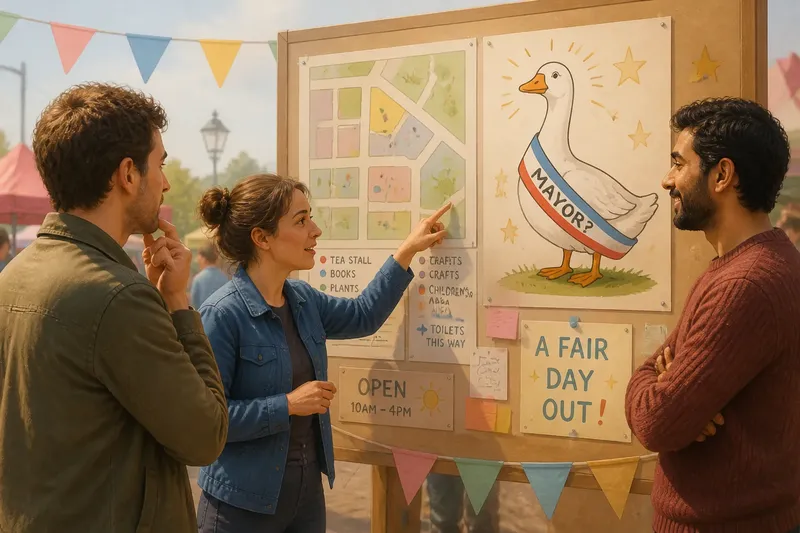
At the street fair, a passer-by studies the noticeboard and asks whether the goose in a mayoral sash is running for office. Mara, who designed the practical information, points to the map. Dev, who drew the goose, grins. Their committee’s argument about what a notice should do is still there, but the scene has reached its last beat. A comedy ending without a neat bow can close the story without settling every dispute.
The useful distinction is between an unresolved disagreement that has been shaped into an ending and one that simply stops. A comic story need not reconcile its characters, but its last scene should give the audience something definite to see: a consequence, a choice, or a final image that belongs to the conflict.
What makes a comedy ending without a neat bow feel complete?
Imagine a neighbourhood committee preparing a noticeboard for a street fair. Mara wants clear opening times, stall locations and practical directions. Dev has been asked to supply a humorous slogan, and believes a large drawing of a goose wearing a mayoral sash will attract attention. Both have useful aims. Their trouble begins when each treats that aim as the proper purpose of the whole board.
The committee chair suggests combining the ideas. Mara places the goose beside the details, but makes it small. Dev enlarges it, pushing the opening time into a corner. Neither rejects compromise outright; each changes it until it serves their own preference. The scene makes their disagreement legible through a shared object, rather than explaining it as a general clash between sense and silliness.
At the fair, visitors ask where the tea stall is. Dev points towards the goose, which is not a useful landmark. Mara adds arrows, and Dev says the board now looks like instructions for leaving. The board has helped and confused people. That mixed outcome gives the argument a visible consequence without turning the crowd into a jury that declares either character right.
How can a final joke close the scene without settling the argument?
After the fair, the committee takes down the notices. A passer-by asks whether the goose is running for office. Mara replies, “Not unless it can explain the map.” The joke works because it combines the two purposes already attached to the board: Dev’s memorable image and Mara’s demand for usable information.
That line does not resolve their design dispute, and it need not. It gives the audience a clear last turn: the goose has attracted attention, while the map still matters. The scene ends on a specific consequence of their collaboration, not on a promise that they will behave differently next time. Their disagreement remains, but the story has completed its comic thought.
This distinction also keeps the characters from becoming mouthpieces for a verdict. Mara is not simply right because directions are useful; Dev is not simply right because the goose is memorable. The joke holds both claims in the same frame, letting the audience notice the gap between what a public notice is meant to do and what people actually remember.
How do you tell deliberate ambiguity from a dropped thread?
Does the ending return to the central conflict?
A deliberate open ending brings the original disagreement into its final scene, even if it appears in a new form. If the story stops attending to its central relationship without a final action or image, the unfinished feeling may come from a missing turn.
Does the last scene show a consequence?
Look for something the conflict has changed in the shared situation, such as visitors asking for directions or the passer-by noticing the goose. A consequence gives the ending shape without requiring a winner.
Does the final joke belong to these characters?
The closing gag should grow from habits the story has already established. The goose and map belong together because the argument has made both attention and legibility part of the same problem.
Does the story leave a question, or merely omit an answer?
An open ending can leave room to wonder how the characters will work together while still completing its present scene. If the audience cannot tell what the last moment means for the conflict, the story may have withheld a needed beat rather than chosen ambiguity.
What does the noticeboard example leave unresolved?
Say the committee chair asks Mara and Dev to prepare a fresh notice for next year’s fair. They agree to work together, but Mara wants the map to lead and Dev wants the goose to remain prominent. At their first planning meeting, they place the map in the centre and the goose at the side; a visitor then asks about the goose before looking at the directions. Mara moves the map higher, while Dev keeps the drawing. The result is not a settled design rule: the map is easier to find, and the goose still attracts questions. The trade-off is visible, and the scene can end there without pretending the pair have reached agreement.
It is not worth inventing an off-screen reconciliation just to tidy the ending. For this kind of comedy, the more useful question is whether the final image completes the scene’s particular argument. Here, a goose beside a map does so: it leaves the audience with a concrete clash between being noticed and being understood.