Lampoon or Parody: What Is the Joke Pointed At?
Lampoon or parody: learn to tell a comic attack from a borrowed style, so you can identify what a joke criticises and what it merely imitates.
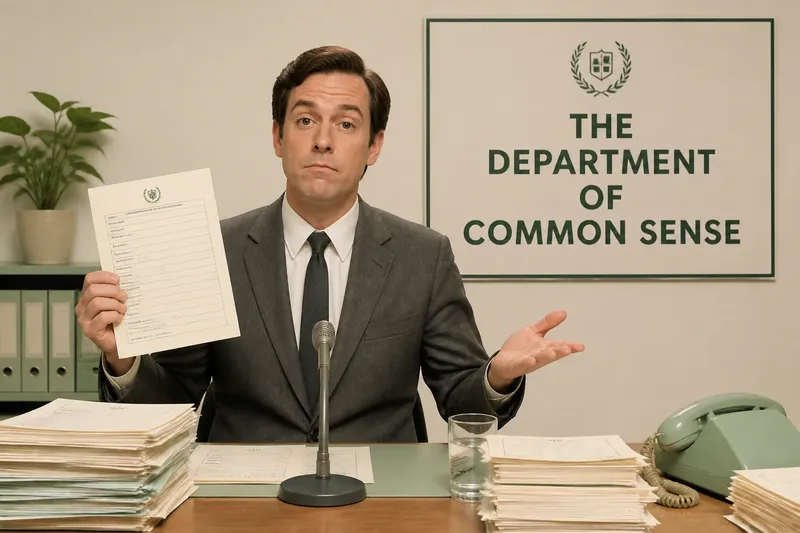
A sketch opens with a solemn presenter, a polished desk and a graphic announcing “The Department of Common Sense”. The presenter explains, with grave confidence, why every household problem can be solved by issuing a form. Is the joke aimed at official language, bureaucracy’s faith in paperwork, or the style of television announcements? Lampoon and parody answer different questions: one identifies the comic attack, the other the device used to make it.
What does lampoon attack?
A lampoon is ridicule directed at a person, institution, belief, public habit or social arrangement. It makes its target look foolish, vain, evasive or absurd, inviting the audience to question the behaviour or values on display.
The method may be exaggeration, irony, caricature or an unfair comparison played for comic effect. The important clue is where the joke’s criticism lands. A character who treats a minor inconvenience as a constitutional crisis may expose an inflated sense of importance; the joke is not simply that the character speaks in a grand style.
What does parody imitate?
Parody borrows a recognisable style, format, genre, voice or convention. It might copy the clipped narration of a detective story, the immaculate staging of an advert or the solemn delivery of an official announcement. Recognition gives the audience a familiar pattern to compare with its comic distortion.
That borrowing does not, by itself, condemn the source. A writer can enjoy a genre’s habits and heighten them for amusement, without arguing that the genre or its audience is foolish. To identify parody, ask what pattern the work expects its audience to recognise.
Why can one joke be both?
Lampoon names a target; parody names a method. A sketch can imitate a form while using that imitation to attack an institution or idea. Confusing the two makes a mixed joke seem harder to describe than it is.
Imagine a fictional sketch set at a council meeting. Its chairperson repeats “for clarity” before every sentence, then uses a maze of forms to dodge a direct question about a broken public fountain. The copied meeting style supplies the parody; the evasion and faith in procedure make the scene a lampoon of bureaucratic avoidance.
Remove the imitation and the criticism may still work in ordinary dialogue. Remove the criticism and the formal language may still amuse through recognition. In this invented scene, both parts have a job, but they are not the same job.
How do you distinguish lampoon from parody?
What is being copied?
Name the borrowed voice, format, genre or convention. If the joke depends on recognising a familiar pattern, parody is part of its method.
What conduct or belief is criticised?
Look for the gap between what a character claims and what they do, or between an institution’s promises and its behaviour. That gap can reveal a lampoon’s target more clearly than a costume or catchphrase.
Would the criticism survive in another style?
If the same point could be made in plain dialogue, the target is likely a belief or behaviour rather than the copied form. If changing the style removes the central joke, parody carries more of the effect.
Who is the visible target, and who benefits?
A pompous official may receive the immediate ridicule while the deeper target is the institution that rewards pompous performance. Consider what the scene asks the audience to question, rather than assuming the person shown is the only subject of the joke.
What if the joke’s target is unclear?
A sharp impersonation can leave its audience unsure whether it mocks a speaker’s reasoning, their accent or the people who take them seriously. Those choices have different implications. Resemblance alone does not settle the question.
For a writer, concrete details can clarify the direction. To criticise evasive reasoning, show a direct question receiving a grand detour and a change of subject. To tease a genre convention, heighten its devices: every clue becomes portentous, every pause a revelation. These choices give the audience more to read than a borrowed voice.
For a reader, notice what the joke rewards and what it punishes. What is not worth the effort is forcing every mixed work into one permanent category; a sketch can borrow a format and criticise an institution in the same scene. Describe those functions instead.
How should you describe lampoon and parody?
Use a sentence that names both the method and the target. “It parodies the language of official announcements to lampoon the belief that paperwork can solve every problem” identifies what is copied and what is criticised.
If the target remains uncertain, describe the evidence without claiming to know the creator’s intent. You could say that a sketch borrows an official format and appears to ridicule its speaker’s evasions, while leaving open whether it also targets the format itself. Lampoon or parody is a useful distinction because it explains not only what a joke resembles, but what that resemblance is made to do.