The Straight Character Is Not Always the Serious One
The straight character in comedy can sharpen absurdity without becoming a mouthpiece, helping writers give the role specific motives, comic agency and social bite.
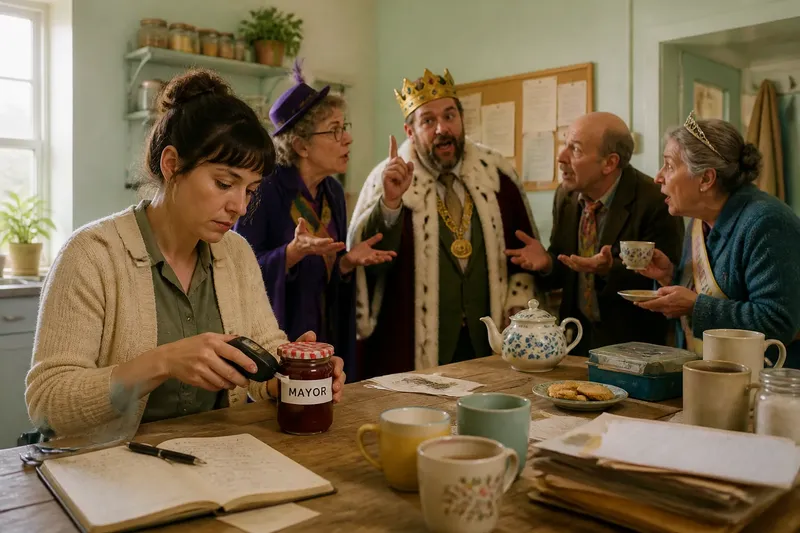
In a crowded kitchen, one character calmly labels a jar of jam while the others debate whether it has been elected mayor. The label-maker may be the straight character, but that does not make them the story’s serious one. In comedy, the straight character is often the person whose reactions give absurd behaviour a shape—and whose assumptions may be part of the joke.
That distinction matters. A grounded character can help an audience read a comic scene without acting as its official interpreter. They might be practical, vain, anxious, rigid or quietly opportunistic. Their steadiness is a position in the scene, not a certificate of good sense.
What does a straight character do in comedy?
A straight character provides contrast. When one person treats an irrational situation as ordinary, another person’s refusal, confusion or measured response helps make the situation legible. The contrast need not come from solemnity. It can come from a different appetite, social role or idea of what counts as acceptable behaviour.
Consider a character who keeps the accounts while a club’s members invent increasingly elaborate titles for themselves. Their ledger gives the scene a practical point of reference. Yet the accountant may also be delighted by the titles, provided they come with access to the club’s best biscuits. The character helps organise the joke while revealing a motive of their own.
How can the character sharpen absurdity?
A comic premise becomes clearer when someone responds in a way that exposes its rules. That response may be a question, a correction, a refusal to join in or an attempt to make nonsense administratively respectable. Each choice draws attention to a different feature of the scene.
- Ask for the procedure. If the character requests the proper form or chain of approval, then the foolish custom can look like an institution; if that would only slow the scene, let them bypass the process and pursue a personal aim.
- Notice who pays the cost. If the character points out who is doing the unpaid work, then the joke can expose the arrangement behind the spectacle; if the cost is not central, have them focus on another consequence that matters to them.
- Accept the premise too readily. If calm compliance makes the absurdity stranger, then let the character go along for a private reason; if compliance blurs the conflict, let them bargain or refuse.
- Refuse the expected reaction. If a quiet change of subject leaves a grand performance stranded, then use it instead of an explanatory speech; if the shift hides the stakes, have the character make a pointed choice.
- Change tactics. If correction stops working, then let the character switch to bargaining or evasion; if the new tactic serves no desire of theirs, give them a clearer personal objective.
- Show a blind spot. If the character notices everyone else’s foolishness but not their own advantage, then let that selective attention become part of the joke; if the blind spot feels arbitrary, connect it to a habit, fear or interest.
These are dramatic actions, not interchangeable punchlines. The useful response is the one that gives the character something to pursue. Otherwise, the “straight” role risks becoming a human pause button: everyone stops, they look unimpressed, and the scene waits for the next joke.
Why can a grounded character be wrong?
Grounded behaviour is not the same as moral or intellectual authority. A character can be competent within one system and foolish about the values that system protects. They may recognise a ridiculous rule but defend it because it benefits them, or object to a disruption only because it has inconvenienced them personally.
Say a caretaker at a community hall records each increasingly absurd request for a ceremonial key. The starting point is a queue of applicants and a notebook of requests. The caretaker first logs every claim in order, then an applicant offers to repair the hall’s leaking noticeboard, and the caretaker moves that request to the top of the list. The resulting scene makes the caretaker’s practical self-interest visible: their notes help track the escalation, but their judgement is not neutral.
The caretaker is neither a neutral observer nor a simple villain. Their attention is selective. They see the silliness, but they also see an opportunity. That makes their grounded quality a source of comic tension rather than proof that their judgement is sound.
What should a writer give the straight character?
Give the character a desire that exists before the absurdity arrives. They might want to finish a task, keep a friendship, protect their standing or avoid a public display. Then make the comic situation interfere with that desire in a specific way. A reaction becomes more than commentary when the character has something to lose or gain.
It also helps to decide what the character notices. One person sees wasted time; another sees a status contest; another notices that a supposedly harmless joke keeps landing on the same person. The choice directs attention, but it also tells us who this person is. A character who notices everything except their own advantage is still revealing something.
Finally, let the character change tactics. They may begin by correcting the others, switch to bargaining, then discover that their own participation has helped the nonsense continue. A change in strategy keeps the role active and prevents the character from becoming a fixed measuring stick against which everyone else is judged.
Which questions help distinguish a straight character?
Does a straight character have to be sensible?
No. The character needs to provide a useful contrast, not an unblemished verdict. Their blind spots can form part of the comedy, particularly when they mistake habit or self-interest for common sense.
Can a straight character be funny?
Yes. Their timing, evasions, stubbornness or appetite for order can produce jokes of their own. The difference is not that one character makes jokes and the other does not; it is that their comic behaviour arises from a contrasting relationship to the scene.
How can the character avoid becoming a mere contrast?
Give them a goal that would matter even if nobody else behaved absurdly, then make their response change what happens next. Their choices should reveal a particular appetite, fear or advantage, rather than simply mark the other characters as ridiculous.
Can a comic scene work without a straight character?
Certainly. A scene can build its rhythm through competing impulses, repetition or a shared acceptance of an odd premise. A grounded character is one possible source of contrast, not a compulsory witness appointed to explain the joke.
When does the role become too convenient?
The character becomes too convenient when they exist only to announce that something is strange, then disappear once the audience has understood it. The same problem appears when everyone else behaves foolishly so that the grounded one can seem wise by comparison. Such a setup may make a scene easy to follow, but it gives the character little life beyond keeping score.
There is also a difference between clarity and explanation. A pointed reaction can clarify a comic situation; a speech that interprets every motive may stop the scene to deliver its own programme note. Often the more revealing choice is smaller: a character puts the absurd form in the correct tray, then keeps the tray for themselves.
What is not worth the effort is making the character frown at every joke as proof of their function. A repeated look of disbelief quickly becomes another predictable routine. A changing response—interest, annoyance, calculation, reluctant enjoyment—gives the scene more to work with.
How does the straight character reveal a story’s assumptions?
Comic characters make a story’s assumptions visible. The grounded figure can show what a group considers normal, what it treats as an inconvenience and who is expected to accommodate the rest. That does not mean every scene needs to become a verdict on society. Small decisions can reveal the customs surrounding the absurdity without turning the character into a speech-maker.
The straight character in comedy is most useful when they remain a person rather than a device for contrast. Let them clarify the scene, but give that clarity a source: a job, a fear, a habit or a private advantage. The joke often sharpens when the calmest person in the room has the most to gain from keeping things exactly as they are.